When we visited the Zen Center in Madison, WI, I wasn't sure what to expect. Our professor had told us not to expect much in the way of ornamental things or decorations, but I think we were all pleasantly surprised. (It was better than the Mosque.)
The members of the center wore grey robes with brown aprons. The apprentices had shorter robes, and the more advanced members of the center wore floor-length robes.
I thought the members of the center were very kind and inviting to us, and our group that night was very large, probably over 30 people. They said they usually have a very small group, so this was a change for them too.
We all sat in a circle in their meditation room, and first a member of the center lit candles on the small altar and bowed to the statue of Buddha on it. Next, we participated in a short chanting meditation session and then a 10-minute silent meditation session. I was really surprised by the way we were instructed to keep our eyes open during the silent meditation. It was really hard for me to, and I still found myself closing my eyes once in a while. We weren't supposed to look at anyone else, but at the floor in front of where we were seated.
I really liked the meditation session. It's something I can see myself "getting into" at some point in my life, in that way or through yoga. As a side note, it must be nice to be able to spend 25 minutes a day just being quiet and being with yourself. I'm not sure where I'd squeeze it in... although you always make time for what's important. :)
Friday, January 23, 2009

Sunday, January 18, 2009
Sri Venkateswara Swami Temple in Aurora
When we visited the Sri Venkateswara Swami Temple in Aurora, I really wasn't sure what to expect. For me, it was very strange to actually see all of the elements we'd discussed in class, happening here in America and not in Asia. Somehow, it all seemed out of place around here.
Our tour guide started by giving us a little bit of Indian history, as well as differentiating between North Indian and South Indian temples. This temple was a South Indian temple, with all of the statues made from black granite stone. It has been open for around 20 years and is dedicated to both Shiva and Vishnu. Before we went into the temple area, we had to take our shoes off, for cleanliness, because people pray and sit on the floor often. Around the temple area, small rooms lined the main room with shrines dedicated to many different gods and their avatars.
Some things that surprised me about the Temple were how fresh offerings were put in front of and on the statues every day. As a classmate mentioned, I'd like to know how much it cost to decorate the place daily! The flower garlands on each statue would be extremely costly to keep fresh, and the offerings of fruit and milk would also be expensive.
Miniature forms of the gods are all "woken up" in the morning and put to bed at night in small beds by the 4 priests, or brahmin, of the temple. The main gods are given baths with milk, honey, and spices every day, while the lesser gods are given baths once or twice per week on a set schedule.
One thing that bugs me about worshiping statues as "gods" is that, in every Hindu temple in the world, there are copies of the same god. I realize that the statues are incarnations of the god they represent. But in India, where there would be a temple in every town, it seems that worshiping each statue made of each god every day in such a time-consuming (not to mention, wasteful) way is ridiculous.
How does giving a marble statue a milk bath every day lead towards inner peace and release from samsara? I don't get it. I realize the rituals are there for a reason, to provide structure in a believer's life, but there has to be a point where "enough's enough." Can that really help? Wouldn't doing things for the community, or even prayer and reflection, be more useful than all the work it takes to run the temple in that way?
Our tour guide started by giving us a little bit of Indian history, as well as differentiating between North Indian and South Indian temples. This temple was a South Indian temple, with all of the statues made from black granite stone. It has been open for around 20 years and is dedicated to both Shiva and Vishnu. Before we went into the temple area, we had to take our shoes off, for cleanliness, because people pray and sit on the floor often. Around the temple area, small rooms lined the main room with shrines dedicated to many different gods and their avatars.
Some things that surprised me about the Temple were how fresh offerings were put in front of and on the statues every day. As a classmate mentioned, I'd like to know how much it cost to decorate the place daily! The flower garlands on each statue would be extremely costly to keep fresh, and the offerings of fruit and milk would also be expensive.
Miniature forms of the gods are all "woken up" in the morning and put to bed at night in small beds by the 4 priests, or brahmin, of the temple. The main gods are given baths with milk, honey, and spices every day, while the lesser gods are given baths once or twice per week on a set schedule.
One thing that bugs me about worshiping statues as "gods" is that, in every Hindu temple in the world, there are copies of the same god. I realize that the statues are incarnations of the god they represent. But in India, where there would be a temple in every town, it seems that worshiping each statue made of each god every day in such a time-consuming (not to mention, wasteful) way is ridiculous.
How does giving a marble statue a milk bath every day lead towards inner peace and release from samsara? I don't get it. I realize the rituals are there for a reason, to provide structure in a believer's life, but there has to be a point where "enough's enough." Can that really help? Wouldn't doing things for the community, or even prayer and reflection, be more useful than all the work it takes to run the temple in that way?
Tuesday, January 13, 2009
Islamic Center of Cedar Rapids
Our trip to the Mosque in Cedar Rapids turned out differently than I'd hoped. It seemed like we got a lot of the same information from our readings and classes and not a lot of personal opinion or experiences from our tour guide, Hassan Igram (sp?), who was the Chairman of the Islamic Center. This could also be because our previous tour guides were so good at making connections between religions and comparing practices with things that we are used to doing in our own lives. Getting to hear him read in Arabic was interesting.
Two things that surprised me about the mosque were the simplicity of their worship space and the way their members are growing in number so quickly.
Their worship area had plain red carpet and blank walls, with an "archway" in the direction of Mecca in the corner of the room. After thinking about it, it wasn't clear to me whether women were allowed to worship there with the men. Because, previously in the tour, our tour guide mentioned a room for women and children where they went during services. This is something I would have asked if I had thought of it during our tour.
I know the purpose of not having many decorations or distractions in their worship space is to help them concentrate and emphasize the focus on God ALONE, but I also know that other mosques (in bigger cities with more Muslims) are very ornate and beautifully decorated, like this one:
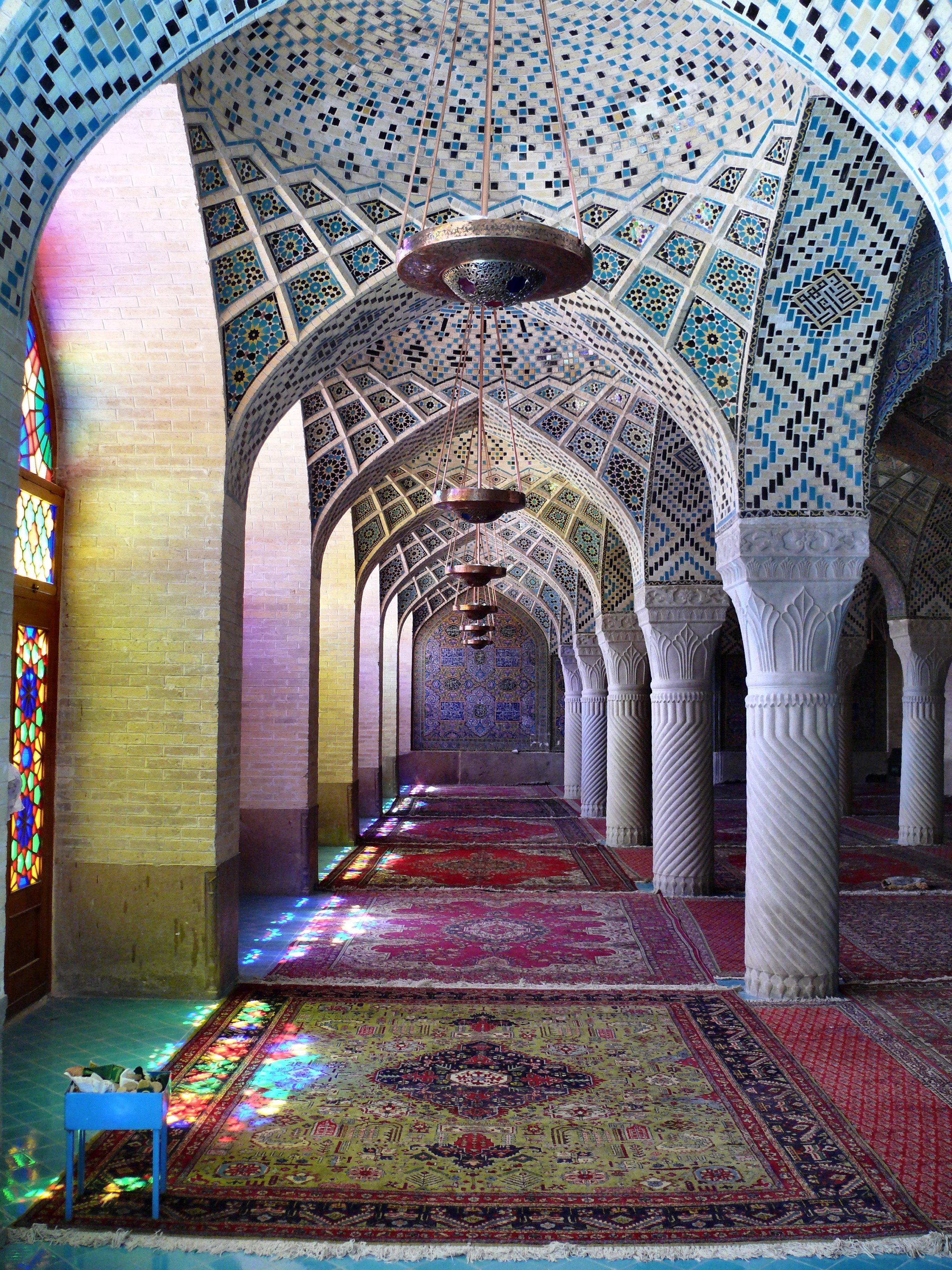
The picture above is more like what I was expecting from our trip. Since the Mosque in Cedar Rapids only has a weekly membership of about 150 people, they probably don't have much money to spend on decorating their spaces ornately.
However, Islam is growing at a rate of 2.9% every year, and Cedar Rapids' Islamic Center doesn't seem any different. Our tour guide said on some holidays they get too many people and need to move their service into the gymnasium. Eventually, they will need to expand their building to accommodate larger crowds of attendees.
On a more personal note, one of my good friends, Olli, is Muslim, although he doesn't take his faith as seriously as some. He's become a bit americanized, because he was born here in America. (His parents are from Pakistan.) Through him, I knew a lot about Ramadan and some other practices and holidays, so a lot of this was review for me. All in all, I wasn't extremely impressed by the center in Cedar Rapids. I hope our trip to the Hindu Temple on Friday goes better!
Two things that surprised me about the mosque were the simplicity of their worship space and the way their members are growing in number so quickly.
Their worship area had plain red carpet and blank walls, with an "archway" in the direction of Mecca in the corner of the room. After thinking about it, it wasn't clear to me whether women were allowed to worship there with the men. Because, previously in the tour, our tour guide mentioned a room for women and children where they went during services. This is something I would have asked if I had thought of it during our tour.
I know the purpose of not having many decorations or distractions in their worship space is to help them concentrate and emphasize the focus on God ALONE, but I also know that other mosques (in bigger cities with more Muslims) are very ornate and beautifully decorated, like this one:
The picture above is more like what I was expecting from our trip. Since the Mosque in Cedar Rapids only has a weekly membership of about 150 people, they probably don't have much money to spend on decorating their spaces ornately.
However, Islam is growing at a rate of 2.9% every year, and Cedar Rapids' Islamic Center doesn't seem any different. Our tour guide said on some holidays they get too many people and need to move their service into the gymnasium. Eventually, they will need to expand their building to accommodate larger crowds of attendees.
On a more personal note, one of my good friends, Olli, is Muslim, although he doesn't take his faith as seriously as some. He's become a bit americanized, because he was born here in America. (His parents are from Pakistan.) Through him, I knew a lot about Ramadan and some other practices and holidays, so a lot of this was review for me. All in all, I wasn't extremely impressed by the center in Cedar Rapids. I hope our trip to the Hindu Temple on Friday goes better!
Thursday, January 8, 2009
Temple Beth El Synagogue
The Synagogue in Madison was not what I was expecting. I'm not sure precisely what I expected, but my experience there definitely broke some stereotypes for me and affirmed others.
One of the most interesting parts of the temple, to me, was how plainly it was decorated and the simple architecture of the meeting room. All Jewish synagogues are supposed to have certain characteristics: natural lighting, be directed towards the east, and contain a space behind a curtain for an "ark" with Torah scrolls inside it.
The ceiling had a skylight with a geometric pattern laid into it, where many 6-pointed stars could be seen. Our tour guide, Beth, said he son loved to count how many stars he could find in the skylight. For whatever reason, I thought the synagogue would be more ornately decorated or at least have more elements to it than simply the ark with the Torah, a podium, and a table on which to read the Torah scrolls.
Even though the synagogue was decorated relatively simply compared to the Dyersville Basilica, there were some elements that contained some flair and artistic interpretation. The curtains in front of the ark were decorated with crests of the 12 tribes of Israel: Joseph's, and all of his 11 brothers'. The Torah scrolls themselves were also decorated with covers and silver ornaments as signs of respect. I didn't expect these to be ornamented in any way like this, since I assumed that would be detracting from them in some way. However, they do need to be protected because they are so valuable! Each Torah scroll cost between $15,000 and $30,000.
Even though the design of the synagogue and the decorations there were not what I was expecting, Beth's description of Jewish ceremonies were basically what I had heard from other sources. Their sabbath service lasts at least 3 hours long and is performed completely in Hebrew. Visitors are always welcome, but they will never be asked to participate or convert to Judaism by one of the synagogue's members. This struck me as interesting because it seems like Judaism isn't a very popular religion and they probably need more members. On the other hand, converting to Judaism is a long, lengthy process and I'm not sure it would necessarily be encouraged for people who were not of "Jewish" descent.
One of the students asked who was considered "Jewish," and Beth replied anyone who is descended from the Biblical Abraham, but they may not be practicing. Even in Madison, there is a large group of "Jews" who only come to synagogue on the three holiest days of the year, the two days of Rosh Hashana, and on Yom Kippur. Beth said they normally have about 75-100 people at a Sabbath service, but on those days they can reach 1,000 people in attendance. I think this shows that even Jews, who the rest of the world might consider to be more devoted to their religion or at least have more of an obligation to practice it, can be "lazy" in the worship too, (like Christians that only go to church on Easter and Christmas.)
When visiting their synagogue's kitchen, it seemed easier to understand why people say Jewish life is all about rules. For them, however, all of the rules are like the walls holding their lives together. If you break one or two, eventually they'll all fall away.
Keeping kosher looks like a 24/7 job. As a college student living on my own, it's tough just to throw a meal together some days. Having to put that much thought into what I could or couldn't eat, whether at home or in public, would be extremely hard. I couldn't do it!
To sum up, I learned a lot during our visit to the synagogue. I thought Beth did a wonderful job explaining many little aspects of life that we wondered about, like how the children reacted to certain things. Those little details are often the most intriguing.
One of the most interesting parts of the temple, to me, was how plainly it was decorated and the simple architecture of the meeting room. All Jewish synagogues are supposed to have certain characteristics: natural lighting, be directed towards the east, and contain a space behind a curtain for an "ark" with Torah scrolls inside it.
The ceiling had a skylight with a geometric pattern laid into it, where many 6-pointed stars could be seen. Our tour guide, Beth, said he son loved to count how many stars he could find in the skylight. For whatever reason, I thought the synagogue would be more ornately decorated or at least have more elements to it than simply the ark with the Torah, a podium, and a table on which to read the Torah scrolls.
Even though the synagogue was decorated relatively simply compared to the Dyersville Basilica, there were some elements that contained some flair and artistic interpretation. The curtains in front of the ark were decorated with crests of the 12 tribes of Israel: Joseph's, and all of his 11 brothers'. The Torah scrolls themselves were also decorated with covers and silver ornaments as signs of respect. I didn't expect these to be ornamented in any way like this, since I assumed that would be detracting from them in some way. However, they do need to be protected because they are so valuable! Each Torah scroll cost between $15,000 and $30,000.
Even though the design of the synagogue and the decorations there were not what I was expecting, Beth's description of Jewish ceremonies were basically what I had heard from other sources. Their sabbath service lasts at least 3 hours long and is performed completely in Hebrew. Visitors are always welcome, but they will never be asked to participate or convert to Judaism by one of the synagogue's members. This struck me as interesting because it seems like Judaism isn't a very popular religion and they probably need more members. On the other hand, converting to Judaism is a long, lengthy process and I'm not sure it would necessarily be encouraged for people who were not of "Jewish" descent.
One of the students asked who was considered "Jewish," and Beth replied anyone who is descended from the Biblical Abraham, but they may not be practicing. Even in Madison, there is a large group of "Jews" who only come to synagogue on the three holiest days of the year, the two days of Rosh Hashana, and on Yom Kippur. Beth said they normally have about 75-100 people at a Sabbath service, but on those days they can reach 1,000 people in attendance. I think this shows that even Jews, who the rest of the world might consider to be more devoted to their religion or at least have more of an obligation to practice it, can be "lazy" in the worship too, (like Christians that only go to church on Easter and Christmas.)
When visiting their synagogue's kitchen, it seemed easier to understand why people say Jewish life is all about rules. For them, however, all of the rules are like the walls holding their lives together. If you break one or two, eventually they'll all fall away.
Keeping kosher looks like a 24/7 job. As a college student living on my own, it's tough just to throw a meal together some days. Having to put that much thought into what I could or couldn't eat, whether at home or in public, would be extremely hard. I couldn't do it!
To sum up, I learned a lot during our visit to the synagogue. I thought Beth did a wonderful job explaining many little aspects of life that we wondered about, like how the children reacted to certain things. Those little details are often the most intriguing.
Tuesday, January 6, 2009
Dyersville Basilica Vs. New Melleray Abbey
As I start this blog for my World Religions course, I should tell you a little about myself. I currently identify as agnostic. An agnostic believes it’s impossible to know the truth about God and any afterlife that may exist, but simultaneously does not say they do not exist. I suppose I could just say I’m currently undecided.
I was raised non-denominational “Christian” and attended Hope Church here in Dubuque as a child and teen. I have been to “Christian,” Catholic, and Seventh-Day Adventist services, and many different kinds of churches for weddings.
Today at the St. Francis Xavier Basilica in Dyersville, my first impression said: big, gaudy, and CATHOLIC. For me, the Basilica epitomized my mental picture of a Catholic church. While I found the church itself somewhat stereotypical, I thought our tour guide gave a wonderful presentation of the history of the Basilica.

His lively demeanor and vast knowledge showed just how involved the people of Dyersville and the surrounding community are with their church. Our tour guide seemed to think that not a whole lot had changed in Dyersville since the 1860s when the church was first erected by German immigrants. A fellow student pointed out that everyone in all of the paintings and windows was white, more specifically: German. These people wanted their church's decorations to represent their lives and things they related with.

The interior design was completed by a Michigan sister and brother pair of designers, Alfonse and Ladie Brillmeyer (Sp?). It was revamped in the late 1990s by Fr. Petty, who also acquired a set of four 1975 Holy Door Bricks from Rome. These were later installed into the walls of the Basilica, as well as marble from St. Peter's Basilica and pebbles from Lourdes, France.

The altar space holds the tabernacle, relics from countless saints and apostles, images of angels and saints, and the altar and high altar themselves. This space is meant to be imposing, powerful, and other-worldly, and I must say it succeeded in overwhelming me with things to look at and learn about.
All of the relics in the church are regarded as sacred, but they are not integral parts of the church. They add additional meaning and symbolism to each Mass and each visit to the church, but they do not replace the rituals performed. However, they may draw visitors' attentions away from the rituals at hand, even if the distractions are sacred and powerful, like inscriptions on the walls, images of the Blessed Virgin, and miniature angels hanging from the ceiling.
In complete contrast, the New Melleray Abbey and its monks specifically try to stay away from complicating their lives and their worship space with anything unnecessary. In the Abbey's worship hall, the seats are plain gold-colored wood pews with a bench in front for hymnals. The floor is tile, and the walls are built from beautiful white limestone.
When the Abbey was first built in the 1850s by Trappist monks that immigrated from Ireland, fleeing the potato famine, Bishop Loras gave them 500 acres of land outside of Dubuque to built their home. Their chapel was erected in 1865, with limestone walls covered in plaster. Until the 1970s, the building remained relatively unchanged.
However, Fr. Steven, our tour guide at the Abbey, assisted in the renovations of the chapel, revamping the floor, expanding the ceiling, and uncovering the gorgeous white limestone walls.
The current design of the chapel really communicated for me the meaning of their simplistic lifestyle. The monks try to focus their entire life on prayer. Not prayer and helping the poor, or prayer and ministering to the townsfolk, simply prayer. The wooden pews, stark flooring, white stone walls reminiscent of a European castle, and simple, raised wooden altar covered in white linen all had clean lines and absolutely no clutter. The two religious images in the chapel: a picture of Mary and baby Jesus, and a crucifix, were both mounted on simple black metal and were not displayed in prominent places.
Although I was unable to take pictures, I think I could describe everything that was in the Abbey's chapel and meeting room. In contrast, it would take weeks or months to describe everything in the Basilica's worship space. The Abbey, to me, communicated a more devout, disciplined lifestyle than anything I had seen before. Even priests and nuns are allowed to go about the world to some extent, and mingle with others. These monks are cloistered, which means they never leave their Abbey except for some kind of emergency or medical reason. They attend services seven times each day.
If I had to give a tour of these two very different places to someone who wasn't a Christian, like me, I would focus more on the basic purposes and uses for each item in the space, and then move on to the history of the items.
The umbrella of "Christianity" encompasses so many different forms and variations; if someone hadn't grown up around Christianity it would be difficult to explain how these two spaces could relate whatsoever. The simplicity and reverence held at the Abbey for their basic tools of worship contrasts so strongly with the way parishoners could bid money for the best pew in the Basilica, I can barely believe these two spaces share the same "religion."
Even though both the Basilica and the Abbey are both Christian spaces, and contain the same basic items, the level of pomp and show at the Basilica overwhelm the true meanings behind the traditions or rituals performed there. For me, the Abbey conveyed a message of sincerity, symbolized in the way the walls were stripped of their plaster facade. The Basilica conveys pomp, show, and a sense that the way everything looks is more important than what's actually happening. The altar's decorations are gold-plated, not solid gold.
If I were asked which of these two spaces I preferred, I would say I enjoyed both but in different ways. The rich history behind EVERY ITEM in the Basilica was very interesting and informative, and the place is simply beautiful. However, the Abbey conveys a much more sincere, faithful, and sacred tone than the Basilica ever could for me, even though they are both Christian spaces worshiping the same God in *mostly* the same way.
I don't believe a place of worship should need to be "decorated." If I ever wanted to commit myself to one religion some day, it would be because I found truth in it. Truth doesn't need decorations.
I was raised non-denominational “Christian” and attended Hope Church here in Dubuque as a child and teen. I have been to “Christian,” Catholic, and Seventh-Day Adventist services, and many different kinds of churches for weddings.
Today at the St. Francis Xavier Basilica in Dyersville, my first impression said: big, gaudy, and CATHOLIC. For me, the Basilica epitomized my mental picture of a Catholic church. While I found the church itself somewhat stereotypical, I thought our tour guide gave a wonderful presentation of the history of the Basilica.
His lively demeanor and vast knowledge showed just how involved the people of Dyersville and the surrounding community are with their church. Our tour guide seemed to think that not a whole lot had changed in Dyersville since the 1860s when the church was first erected by German immigrants. A fellow student pointed out that everyone in all of the paintings and windows was white, more specifically: German. These people wanted their church's decorations to represent their lives and things they related with.
The interior design was completed by a Michigan sister and brother pair of designers, Alfonse and Ladie Brillmeyer (Sp?). It was revamped in the late 1990s by Fr. Petty, who also acquired a set of four 1975 Holy Door Bricks from Rome. These were later installed into the walls of the Basilica, as well as marble from St. Peter's Basilica and pebbles from Lourdes, France.
The altar space holds the tabernacle, relics from countless saints and apostles, images of angels and saints, and the altar and high altar themselves. This space is meant to be imposing, powerful, and other-worldly, and I must say it succeeded in overwhelming me with things to look at and learn about.
All of the relics in the church are regarded as sacred, but they are not integral parts of the church. They add additional meaning and symbolism to each Mass and each visit to the church, but they do not replace the rituals performed. However, they may draw visitors' attentions away from the rituals at hand, even if the distractions are sacred and powerful, like inscriptions on the walls, images of the Blessed Virgin, and miniature angels hanging from the ceiling.
In complete contrast, the New Melleray Abbey and its monks specifically try to stay away from complicating their lives and their worship space with anything unnecessary. In the Abbey's worship hall, the seats are plain gold-colored wood pews with a bench in front for hymnals. The floor is tile, and the walls are built from beautiful white limestone.
When the Abbey was first built in the 1850s by Trappist monks that immigrated from Ireland, fleeing the potato famine, Bishop Loras gave them 500 acres of land outside of Dubuque to built their home. Their chapel was erected in 1865, with limestone walls covered in plaster. Until the 1970s, the building remained relatively unchanged.
However, Fr. Steven, our tour guide at the Abbey, assisted in the renovations of the chapel, revamping the floor, expanding the ceiling, and uncovering the gorgeous white limestone walls.
The current design of the chapel really communicated for me the meaning of their simplistic lifestyle. The monks try to focus their entire life on prayer. Not prayer and helping the poor, or prayer and ministering to the townsfolk, simply prayer. The wooden pews, stark flooring, white stone walls reminiscent of a European castle, and simple, raised wooden altar covered in white linen all had clean lines and absolutely no clutter. The two religious images in the chapel: a picture of Mary and baby Jesus, and a crucifix, were both mounted on simple black metal and were not displayed in prominent places.
Although I was unable to take pictures, I think I could describe everything that was in the Abbey's chapel and meeting room. In contrast, it would take weeks or months to describe everything in the Basilica's worship space. The Abbey, to me, communicated a more devout, disciplined lifestyle than anything I had seen before. Even priests and nuns are allowed to go about the world to some extent, and mingle with others. These monks are cloistered, which means they never leave their Abbey except for some kind of emergency or medical reason. They attend services seven times each day.
If I had to give a tour of these two very different places to someone who wasn't a Christian, like me, I would focus more on the basic purposes and uses for each item in the space, and then move on to the history of the items.
The umbrella of "Christianity" encompasses so many different forms and variations; if someone hadn't grown up around Christianity it would be difficult to explain how these two spaces could relate whatsoever. The simplicity and reverence held at the Abbey for their basic tools of worship contrasts so strongly with the way parishoners could bid money for the best pew in the Basilica, I can barely believe these two spaces share the same "religion."
Even though both the Basilica and the Abbey are both Christian spaces, and contain the same basic items, the level of pomp and show at the Basilica overwhelm the true meanings behind the traditions or rituals performed there. For me, the Abbey conveyed a message of sincerity, symbolized in the way the walls were stripped of their plaster facade. The Basilica conveys pomp, show, and a sense that the way everything looks is more important than what's actually happening. The altar's decorations are gold-plated, not solid gold.
If I were asked which of these two spaces I preferred, I would say I enjoyed both but in different ways. The rich history behind EVERY ITEM in the Basilica was very interesting and informative, and the place is simply beautiful. However, the Abbey conveys a much more sincere, faithful, and sacred tone than the Basilica ever could for me, even though they are both Christian spaces worshiping the same God in *mostly* the same way.
I don't believe a place of worship should need to be "decorated." If I ever wanted to commit myself to one religion some day, it would be because I found truth in it. Truth doesn't need decorations.
Subscribe to:
Posts (Atom)
